Is That Burning Smell Normal? When to Call a 24 Hour Emergency Heating Service


Sudden Furnace Odors: Normal Startup or Imminent Breakdown?
Have you ever turned on your heat for the first time in months, only to be greeted by a sharp, alarming burning odor spreading through your vents? When searching for reliable home maintenance tips and troubleshooting, one of the most common concerns our technicians at Elico Heating & Cooling hear from homeowners is distinguishing between a harmless startup smell and a dangerous mechanical failure. That initial scent of something burning can trigger immediate panic, leaving you wondering if you should evacuate the house, grab a fire extinguisher, or simply wait it out.
Making the right call in these moments is critical for protecting both your family's safety and your property. As the first October cold snap approaches, knowing exactly what to listen for, what to smell, and when to turn the system off can save you from a catastrophic breakdown. If you are ever in doubt about the safety of your system, reaching out for professional heating services is always the smartest first step.
How Long Should a Furnace Smell Like Burning Dust?
During the long spring and summer months, your furnace sits completely dormant. While your air conditioner works overtime, the internal heating components—specifically the heat exchanger and the burners—quietly collect a layer of household dust, pet dander, and airborne particles. When sudden temperature drops catch homeowners off guard in Valparaiso, prompting an immediate switch from cooling to heating, those accumulated particles are instantly subjected to intense heat.
The result is a distinct, dusty, burning odor that permeates the house as the blower motor pushes the warmed air through your ductwork. This is a completely normal physical reaction, but it is important to know exactly how long this phase should last so you can identify when something is actually wrong.
The 30-Minute Threshold
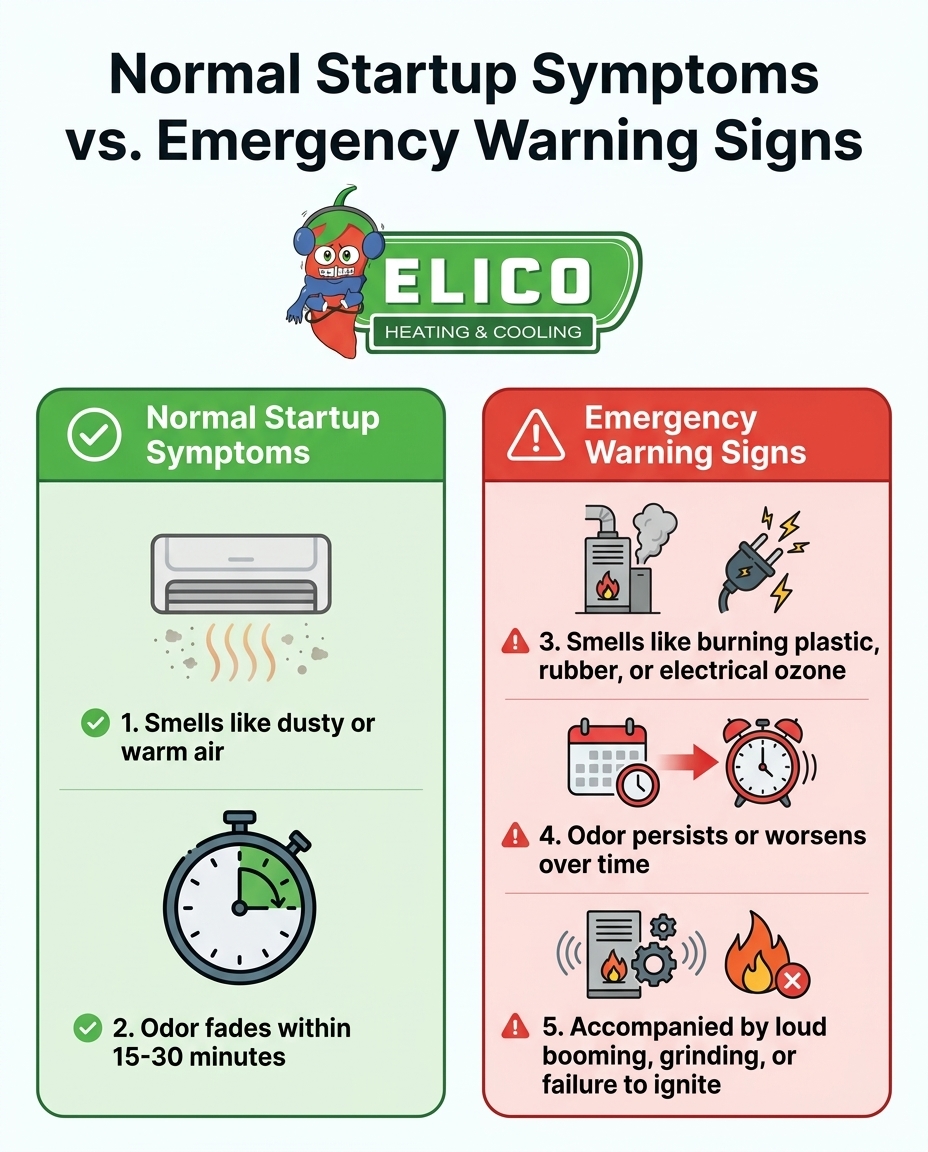
Based on our years of hands-on experience servicing heating systems throughout Northwest Indiana, we tell our customers that as a general rule, the harmless burning dust odor should begin to dissipate within 15 to 30 minutes of the furnace's first sustained heating cycle. During this initial half-hour, you should notice the smell steadily decreasing in intensity, not getting stronger.
What to monitor during the first half-hour:
• Odor intensity: The smell should peak within the first five minutes and fade gradually.
• Airflow quality: The air coming from the vents should feel warm and steady, without any visible smoke or haze.
• System cycling: The furnace should run continuously until it reaches the thermostat's set temperature, then shut off normally.
To help clear the air during this initial burn-off, it is highly recommended to open a few windows slightly to provide proper cross-ventilation. This allows the harmless odors to escape rather than lingering in your living spaces. However, if the smell persists beyond the 30-minute mark, grows sharper, or changes in character, you have crossed the threshold from normal seasonal startup into a territory that requires a licensed diagnostic.
Symptoms of a Failing Component vs. Harmless Odors
Not all burning smells are created equal. While dust burn-off has a very specific, slightly earthy scent, electrical and mechanical failures produce odors that are much more acrid and alarming. Knowing the difference can prevent a minor component failure from escalating into a severe safety hazard during the first October cold snap.
Even outside of peak winter, unexpected system failures require an immediate, professional response. For example, our team at Elico Heating & Cooling recently helped a homeowner in LaPorte who reached out on short notice when their HVAC system failed unexpectedly. We dispatched a technician quickly to restore operation despite the travel distance. Prompt professional attention is the only way to safely resolve these distinct warning signs.
• Musty, earthy burning smell — Likely Cause: Normal dust burn-off on the heat exchanger. — Required Action: Monitor for 15-30 minutes; ensure adequate ventilation.
• Sharp, metallic electrical odor (ozone) — Likely Cause: Overheating blower motor or failing electrical relay. — Required Action: Turn off system immediately; call for professional repair.
• Melting plastic or rubber smell — Likely Cause: Failing wire insulation or a foreign object in the ductwork. — Required Action: Turn off system at thermostat and breaker; request emergency service.
• Loud booming followed by gas smell — Likely Cause: Delayed ignition causing dangerous gas buildup. — Required Action: Evacuate if gas smell persists; contact emergency services/HVAC tech.
When Odors Indicate Electrical Danger
If you detect the smell of melting plastic, burning rubber, or the distinct metallic scent of electrical ozone, you are no longer dealing with a dirty system. These odors indicate that a component, such as the blower motor, capacitor, or internal wiring, is actively overheating. In these scenarios, the internal safety switches may have failed to shut the system down, meaning the equipment is continuing to run while sustaining damage.
Auditory warning signs often accompany these dangerous smells. A loud grinding noise points to failing motor bearings, while continuous clicking without the burner igniting suggests a faulty igniter or gas valve. If your furnace fails to ignite entirely, or if it ignites with a violent "boom" (delayed ignition), you are facing a serious mechanical issue. Because modern heating systems involve high-voltage electricity, combustible gases, and complex exhaust venting, homeowners must never attempt DIY repairs on internal components. Instead, secure the system by turning it off at the thermostat and scheduling professional furnace repair immediately.
Why Delaying Diagnostics Puts Your Home at Risk
It is incredibly tempting to ignore a strange noise or a lingering odor if the furnace is still technically producing warm air. However, hoping a problem will resolve itself is a dangerous gamble. According to data from the National Fire Protection Association (NFPA), heating equipment is consistently ranked as a leading cause of fires in U.S. homes. A persistent burning smell is often the final warning sign before a minor electrical short becomes a localized fire, or before a stressed heat exchanger cracks entirely.
A cracked heat exchanger is particularly insidious. When the metal chamber that contains the combustion flames develops a hairline fracture, dangerous combustion byproducts—including carbon monoxide—can leak directly into the air circulating through your home. What starts as a minor ignition delay can quickly escalate into a life-threatening situation if left unchecked by a professional.
Beyond the immediate risk of fire or carbon monoxide exposure, delaying diagnostics puts your physical property in jeopardy. In Northwest Indiana, indoor temperatures can drop rapidly during freezing October nights. If a failing component finally gives out completely at 2:00 a.m., your home loses its primary defense against the cold. Our team at Elico Heating & Cooling has seen firsthand how quickly a simple mechanical failure can elevate into a severe property freezing risk, potentially leading to burst pipes and extensive water damage. This is why securing prompt furnace repair in Valparaiso is a critical safety measure, not an optional luxury.
Safe Steps to Take Before the Professional Arrives
While you wait for an emergency technician to arrive, there are several safe, non-technical steps you can take to protect your home and help the technician diagnose the problem faster. Remember, the goal here is basic troubleshooting and safety isolation, not DIY repair.
1. Turn off the heating system at the thermostat: If you smell burning plastic, electrical ozone, or if the dust smell lasts longer than 30 minutes, switch the thermostat to the "OFF" position immediately. Do not let the system continue to cycle.
2. Check your air filter safely: A severely clogged air filter restricts airflow, forcing the blower motor to work harder and run hotter, which can produce a burning odor. Slide the filter out and inspect it. If it is completely caked in gray dust, replace it. However, if the burning smell persists after replacing the filter, leave the system off.
3. Verify the circuit breaker: Check your home's main electrical panel to see if the furnace breaker has tripped. A tripped breaker is a clear sign that the system was drawing too much power, usually due to a failing motor or an electrical short. You may reset it once, but if it trips again immediately, do not force it. Leave it off.
4. Clear the area around the furnace: Ensure there are no stored combustible items—such as cardboard boxes, cleaning supplies, or paint cans—within a three-foot radius of the heating equipment. A cluttered utility room restricts combustion air and creates a severe fire hazard.
Following these steps ensures your home remains safe while you wait for the experts. Regular furnace maintenance prior to the first October cold snap is the best way to prevent these stressful troubleshooting scenarios altogether.
Getting Help Without the Dread of Weekend Emergency Fees
One of the primary reasons homeowners delay calling for help when they smell something burning is the fear of exorbitant after-hours billing. It is a common, understandable anxiety: you notice a strange electrical odor on a Saturday evening, and instead of calling for a diagnostic, you turn the system off and plan to wait until Monday morning to avoid the dreaded weekend emergency fee. In Valparaiso's harsh climate, waiting 36 hours without heat is not just uncomfortable; it is dangerous.
Your family's safety should never be compromised due to billing anxiety. When a heating system exhibits signs of electrical failure or dangerous gas buildup, time is of the essence. This is exactly why eliminating weekend emergency fees fundamentally changes the decision-making process for homeowners. You no longer have to weigh the risk of a house fire or frozen pipes against the cost of a premium weekend dispatch charge.
Real-world emergencies do not respect standard business hours. For instance, one customer contacted our Elico Heating & Cooling dispatch at 11 p.m. on a freezing night because their furnace would not light, leaving their home extremely cold with a two-year-old inside. A technician arrived by midnight, repaired the system immediately, and restored the heat quickly—all without charging an extra late-night fee. A true 24-hour emergency heating service should provide absolute peace of mind, ensuring that when you need help the most, you can get it without financial hesitation. If you want to understand more about this commitment to community safety, you can read about why we eliminated weekend emergency fees.
Frequently Asked Questions About Emergency Heating Issues
Why does my furnace smell like burning on first use?
The burning smell during the first use is typically caused by the combustion of dust and debris that settled on the heat exchanger over the summer. When the burners ignite for the first time, this layer of dust burns off rapidly, creating a distinct, earthy odor. This is a normal process, and the smell should naturally dissipate within 15 to 30 minutes of continuous operation.
When should I call for emergency furnace repair?
You should call for emergency repair immediately if you smell burning plastic, electrical ozone, or raw gas, or if your system makes loud booming sounds upon ignition. Additionally, if the standard dust burn-off smell persists longer than 30 minutes or grows stronger, it is time to shut the system down and contact a professional. Never ignore signs of an electrical short or a delayed ignition.
How long should a furnace smell like burning dust?
A furnace should only smell like burning dust for the first 15 to 30 minutes of its initial seasonal heating cycle. During this brief window, the accumulated debris is safely burned away from the internal components. If the odor lingers for hours or returns on subsequent days, it indicates a deeper mechanical issue that requires a licensed technician's evaluation.
Is a burning smell from the heater dangerous?
It depends entirely on the type of smell and how long it lasts. A brief, dusty smell during the first fall startup is harmless and expected. However, sharp odors resembling melting wire insulation, burning rubber, or persistent smoke are highly dangerous and indicate an active failure that could lead to a localized fire or severe equipment damage.
What does an electrical fire in a furnace smell like?
An electrical fire or failing motor typically produces a sharp, acrid scent that resembles melting plastic, burning rubber, or a metallic "ozone" smell. Unlike the mild, earthy scent of burning dust, an electrical odor is harsh, irritating to the nose, and will often worsen the longer the blower motor runs. If you detect this scent, turn off the system at the thermostat immediately.
Can a clogged air filter cause a burning smell?
Yes, a severely clogged air filter can absolutely cause a burning smell by restricting vital airflow through the system. When the furnace cannot pull in enough air, the blower motor is forced to overwork, causing it to overheat and emit a burning electrical odor. Replacing a dirty filter is one of the first safe troubleshooting steps you should take if you notice unusual smells.
Restore Your Heat and Peace of Mind Today
Distinguishing between a harmless seasonal startup odor and a critical mechanical failure is essential for protecting your home in Valparaiso. If your system is producing persistent burning smells, loud grinding noises, or failing to ignite entirely, prioritizing safety over waiting it out is always the right call. Don't let a minor component failure turn into a mid-winter emergency—reach out to our team at Elico Heating & Cooling today to schedule a professional diagnostic and restore your peace of mind.



HVAC Financing

Blogs
The Mechanics of AC Storm Damage: Why We Repaired a Unit Another Company Condemned

Evaluating Furnace Replacement Quotes: Balancing Brand Reliability Against Ultra-High Efficiency Claims