The Mechanics of AC Storm Damage: Why We Repaired a Unit Another Company Condemned


When the Lights Flicker and the AC Dies: Navigating Post-Storm Diagnostics
The severe weather has finally passed, but your home is growing uncomfortably warm, and your outdoor cooling unit is completely unresponsive. You check the thermostat, you flip the breaker, and yet the condenser outside remains entirely silent. For homeowners in Northwest Indiana, where volatile September weather transitions frequently bring intense lightning and power surges, this is a highly stressful scenario. At Elico Heating & Cooling, we recently encountered a situation that perfectly illustrates the mechanics of AC storm damage: why we repaired a unit another company condemned. The immediate fear during these sudden system failures is that a grid fluctuation has destroyed your entire system, leaving you with a massive, unexpected expense just as we transition toward the heating season.
This panic is often compounded when an initial diagnostic visit results in a recommendation for a total system overhaul. However, our team frequently finds that many units appearing completely dead after a storm are actually suffering from a single, isolated electrical failure rather than catastrophic mechanical destruction. Before you accept a worst-case scenario diagnosis, it is crucial to understand how modern air conditioning systems respond to electrical surges. Knowing the difference between a minor component burnout and a ruined compressor can save your existing equipment, especially during early-fall storms when grid stability is tested.
Understanding Grid Surges During Seasonal Weather Transitions
To grasp why your cooling system is so vulnerable during rapid September weather shifts, our technicians often explain the environmental causes behind mechanical electrical failures. When lingering late-summer heat collides with incoming fall cold fronts, the resulting atmospheric instability generates severe thunderstorms. These storms do not just bring heavy rain; they cause massive fluctuations in the local power grid.
The Path of a Power Surge
The problem: When lightning strikes nearby or the utility grid experiences a sudden spike, that excess high-voltage electricity enters your home's electrical system. Electricity is always seeking the path of least resistance to the ground. Because your outdoor AC condenser requires a massive amount of power to operate, it is wired directly to your main electrical panel with thick, highly conductive wiring. This makes it a prime target for rogue voltage spikes.
The cause: Outdoor units are particularly vulnerable to these surges because they draw significant power and sit entirely exposed to the elements. Unlike your indoor electronics, which might be shielded by localized surge strips, a standard condenser is usually the first major appliance in the line of fire. The surge rushes down the dedicated circuit, overwhelming the components designed to handle standard 240-volt residential power.
The solution: Fortunately, HVAC engineers design these systems with sacrificial components meant to absorb the brunt of electrical anomalies. The primary electrical gatekeeper in your outdoor unit is called the contactor. In our experience at Elico Heating & Cooling, when a massive grid surge hits, this component often takes the full force of the blow, sacrificing itself to protect the much more sensitive, expensive components deeper inside the system. Understanding this specific mechanical defense is the key to recognizing why your system might just be playing dead.
The Illusion of Total Failure: Contactor vs. Compressor
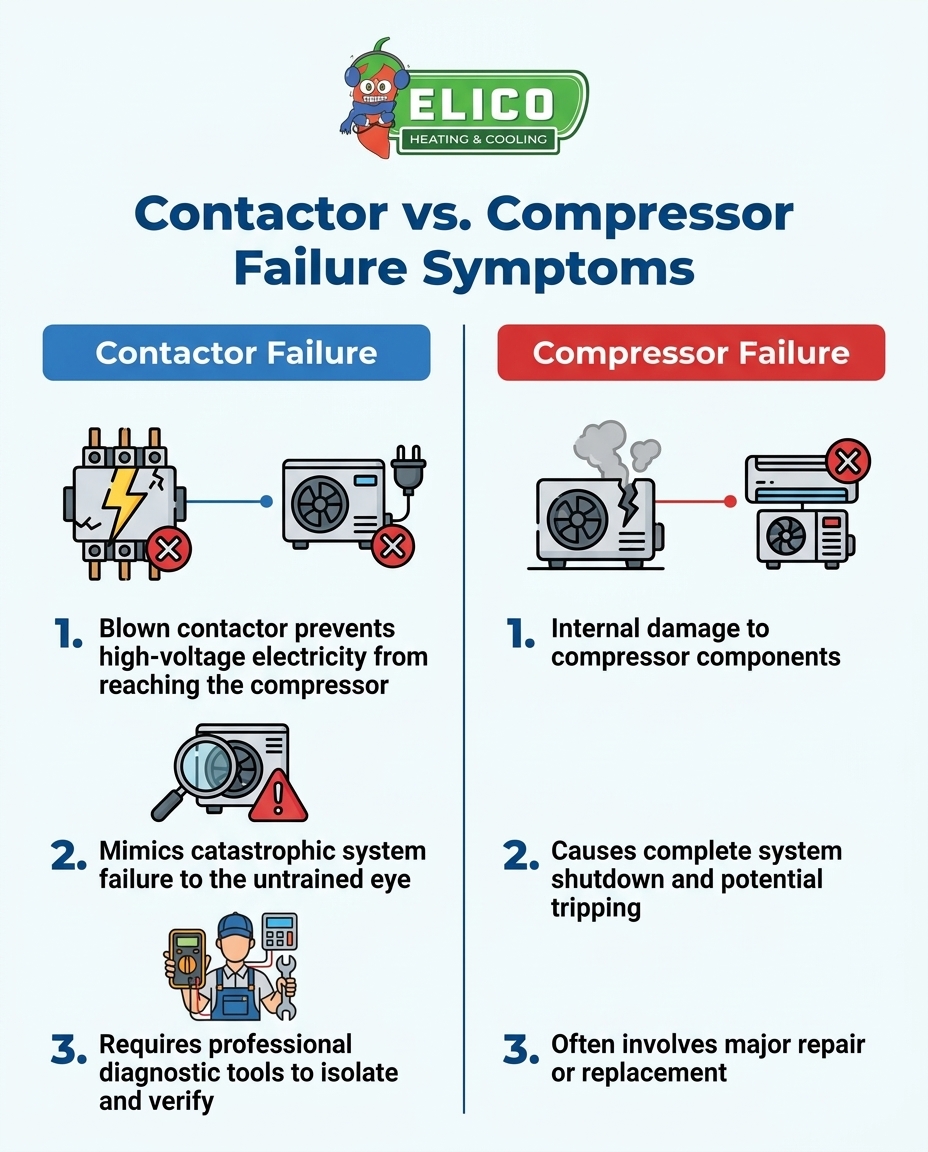
When our team looks at a completely unresponsive condenser, we know the symptoms can easily mimic a total system failure. This illusion is entirely based on the mechanical role of the AC contactor. The contactor is essentially an electrically controlled switch. When your indoor thermostat calls for cooling, it sends a low-voltage signal outside to the contactor. This signal energizes an electromagnetic coil, which pulls a set of heavy-duty metal contacts together. Once those contacts touch, high-voltage electricity is allowed to cross the bridge and power up the compressor and the condenser fan motor.
During a severe grid surge, that massive influx of uncontrolled electricity hits those metal contacts. The extreme heat and voltage can cause the contact points to pit, weld permanently shut, or burn out completely. If the coil burns out or the contacts are destroyed, the bridge is broken. High-voltage electricity is completely blocked from reaching the compressor.
Why It Looks Like the End of the Line
When the contactor fails, the entire outdoor unit goes dark. It will not hum, the fan will not spin, and the compressor will not engage. To the untrained eye—and sometimes to a rushed technician—this looks identical to a seized or shorted compressor. However, the compressor itself might be perfectly healthy, simply sitting in the dark waiting for power that cannot cross the broken bridge.
• Contactor — Role in the System: Acts as the high-voltage electrical gatekeeper. — Symptom When Failed After a Surge: Unit is completely silent and unresponsive. — Repair Scope: Standard electrical component replacement.
• Compressor — Role in the System: Pumps refrigerant through the entire system. — Symptom When Failed After a Surge: Trips breaker immediately, loud grinding, or dead. — Repair Scope: Major mechanical overhaul or full unit replacement.
The only way to differentiate between a burned-out contactor and a catastrophic compressor failure is through precise electrical testing. A professional multimeter continuity test on the contactor will definitively prove whether the switch is capable of passing voltage or if it has been destroyed by the storm. Without this specific test, any diagnosis of a "dead" system is just a guess.
Why Minor Electrical Damage Often Leads to Premature Upgrades
One pattern we see often in the local HVAC industry is the unfortunate recurring habit of lazy diagnostics during busy storm seasons. When severe weather rolls through Northwest Indiana, service call boards light up. Technicians are rushing from house to house, dealing with frustrated homeowners. In this rushed environment, it is incredibly easy for a technician to look at a non-responsive unit, note the recent lightning storm, and immediately assume the worst.
The Cost of Rushed Assumptions
The problem: Isolating electrical components takes time, patience, and a specific technical methodology. Some companies skip these detailed diagnostic phases when they are backed up with calls. If a technician simply checks for power at the main disconnect and sees that the unit isn't turning on, they might quickly condemn the equipment and hand the homeowner a quote for a completely new system.
The cause: This happens because diagnosing a dead compressor is much faster than carefully isolating the low-voltage and high-voltage circuits to find a single burned-out switch. Furthermore, replacing a whole system is a significant project, whereas swapping out a contactor is a straightforward repair.
The solution: At Elico Heating & Cooling, we firmly believe this is where the integrity of honest diagnostics becomes vital. The financial impact on a homeowner when a simple electrical fix is misdiagnosed is massive. A commitment to honest service means taking the extra time to perform a multimeter continuity test on the contactor. It means actively seeking to save the customer's existing equipment with a targeted repair rather than immediately pushing for a lucrative AC replacement. True professionals prioritize accurate diagnostics over quick conclusions, ensuring you only replace your equipment when it is genuinely beyond repair.
Isolating the Issue: How Our Professionals Verify Contactor Health
When a dedicated Elico Heating & Cooling technician arrives to evaluate a system that died after a storm, we follow a strict, comprehensive diagnostic methodology. This process is designed to rule out minor electrical faults before ever assuming the compressor has failed. Because the outdoor condenser operates on highly dangerous 240-volt electricity, this evaluation must never be attempted by a homeowner. High-voltage HVAC components carry fatal risks, and testing them requires specialized insulated tools, extensive safety training, and an active professional license.
Here is an overview of the professional diagnostic approach our team uses for repairing AC units in Valparaiso and isolating post-storm electrical faults:
• Securing the Power Supply: Our technicians always begin by shutting down all high-voltage power at the outdoor disconnect box and the main electrical panel to ensure the unit is entirely safe to inspect.
• Visual Inspection of Components: We remove the access panels to inspect the contactor, capacitor, and wiring for obvious signs of thermal damage, such as scorch marks, melted plastic, or an ozone smell typical of a lightning strike.
• Isolating the Circuit and Continuity Testing: Our team safely isolates the wiring from the contactor to ensure we are only testing the switch itself. Using professional-grade tools, we perform a multimeter continuity test to check the internal resistance of the electromagnetic coil. An "OL" (open loop) reading proves the internal coil has burned out and the bridge is permanently broken.
• Testing the High-Voltage Path: Finally, we evaluate the high-voltage contact points to determine if they have pitted or welded together from the surge.
By following this exact methodology, our technicians achieve a definitive diagnostic reading. It proves beyond a shadow of a doubt whether the compressor is actually damaged or if it is simply starved of power because the contactor sacrificed itself during the storm.
Defending Your HVAC Equipment Against Grid Fluctuations
While knowing how to respond properly to a post-storm failure is the ultimate defense against unnecessary replacements, there are proactive steps you can take to shield your equipment from future grid surges. Standard circuit breakers in your electrical panel are designed to protect against sustained overloads and short circuits, but they react far too slowly to stop the micro-second voltage spikes caused by lightning or utility grid shifts.
To truly defend your system during those volatile fall storms as we prep for the heating season, our team recommends implementing the following protective measures:
• Install a Dedicated HVAC Surge Protector: Unlike a whole-home device, a dedicated HVAC surge protector is installed directly at the outdoor condenser's disconnect box. It is specifically rated to handle the massive influx of voltage that targets the outdoor unit, clamping down on the surge before it can reach the contactor or the compressor.
• Upgrade to Whole-Home Surge Protection: Installed directly at your main electrical panel, these devices provide a first line of defense for all the circuits in your house, reducing the overall voltage that makes it out to the HVAC breaker.
• Maintain Tight Electrical Connections: Loose wiring creates electrical resistance, which generates heat and makes components much more vulnerable to voltage spikes. Routine professional fall maintenance ensures every connection inside the condenser is tight and secure before the harsh winter weather arrives.
• Monitor Your Breakers During Storms: If you know a severe electrical storm is approaching, you can manually turn off the HVAC breaker until the severe lightning passes, completely removing the system from the grid's line of fire.
Taking these proactive steps can significantly reduce your risk of component failure. Furthermore, aligning yourself with a company like Elico Heating & Cooling that values transparent emergency service policies ensures that if a surge does break through, you will receive an honest evaluation of the damage.
Frequently Asked Questions About Post-Storm AC Diagnostics
How do I know if a power surge damaged my AC?
Look for tripped breakers, a burning electrical smell near the condenser, or a unit that completely fails to turn on despite the thermostat calling for cooling. Often, the outdoor unit will remain entirely silent because the internal electrical gatekeepers have burned out to protect the larger system. A professional diagnostic from a trusted team is required to confirm if the damage is limited to minor components or if the compressor was affected.
Can an AC contactor be fixed or does it need replacement?
A burned or welded contactor cannot be repaired; the component itself must be replaced by a professional. Once the internal coil burns out or the metal contacts pit from a high-voltage surge, the part is permanently compromised. Fortunately, our technicians handle contactor replacements regularly, as it is a standard electrical repair and does not require a full system replacement.
Why did my AC stop working immediately after a storm?
Lightning strikes or grid fluctuations often overwhelm the outdoor unit's electrical components, blowing the contactor or capacitor to protect the more expensive compressor. Because these outdoor units draw significant power, they are highly susceptible to voltage spikes traveling through the grid. The sudden loss of function is usually the result of these sacrificial components doing their job.
Does homeowners insurance cover AC power surges?
Many policies cover lightning strikes and sudden electrical surges, but they require a professional diagnostic report detailing the exact cause of failure. Insurance adjusters typically need a licensed HVAC technician to verify that the damage was caused by a specific weather event rather than normal wear and tear. We recommend checking your specific policy details to confirm your coverage limits for electrical damage.
How long does a professional diagnostic test take?
A licensed technician from Elico Heating & Cooling can typically isolate electrical components and verify the health of your system within an hour using specialized diagnostic tools. By utilizing methods like continuity testing, our team can quickly determine if the issue is a simple burned-out switch or a more complex mechanical failure. This thorough testing prevents the premature condemnation of a healthy compressor.
Securing an Honest Second Opinion Before Upgrading
A non-responsive AC unit after a severe early-fall storm does not automatically dictate the end of your system's lifespan. While it is incredibly stressful to be told that your equipment is totaled, the reality of HVAC electrical mechanics shows that minor components like the contactor often mimic the symptoms of catastrophic failure. Proper diagnostic testing, specifically a multimeter continuity test on the contactor, is the only way to know the absolute truth about your equipment's health.
If you have received an initial quote for a full system replacement and feel the diagnosis was rushed, you owe it to yourself to seek a professional second opinion from the team at Elico Heating & Cooling. Honest technicians will take the time to isolate the electrical faults and verify whether the compressor can be saved. If you are facing a frustrating post-storm breakdown, do not rush into a massive investment without all the facts. Reach out for a comprehensive AC repair diagnostic to ensure you are making the best possible decision for your home and your peace of mind.



HVAC Financing

Blogs
The Mechanics of AC Storm Damage: Why We Repaired a Unit Another Company Condemned
Evaluating Furnace Replacement Quotes: Balancing Brand Reliability Against Ultra-High Efficiency Claims