Evaluating Furnace Replacement Quotes: Balancing Brand Reliability Against Ultra-High Efficiency Claims


The Hidden Trap in Fall Furnace Proposals
When you start evaluating furnace replacement quotes: balancing brand reliability against ultra-high efficiency claims is often the most confusing part of the process. You might believe that paying a premium for the absolute highest efficiency rating on the market is always the smartest financial move for your home, but that is a common myth. Homeowners frequently face conflicting proposals during the September pre-heating season, making apples-to-apples comparisons feel nearly impossible. One contractor might aggressively push a top-tier unit with complex features, while another recommends a standard, reliable system.
The core decision you have to make: You must weigh the promised energy savings of those top-tier units against the long-term, proven reliability of a solid mid-tier system. Choosing the right path requires looking past the glossy brochures and understanding how these systems actually operate in the real world. If you need expert heating services, our team can help you find the right fit for your home before the cold weather sets in.
Decoding AFUE Ratings: What Ultra-High Efficiency Actually Means
To make an informed decision, you first need to understand how efficiency is measured. AFUE stands for Annual Fuel Utilization Efficiency. This rating measures the thermal efficiency of your equipment—specifically, how much of the fuel consumed is actually converted into usable heat for your home. For example, a furnace with a 95% AFUE rating turns 95% of its fuel into heat, while the remaining 5% escapes as exhaust.
The mechanics of high efficiency: Standard modern furnaces are already highly efficient. However, ultra-high efficiency models (often reaching 98% AFUE or higher) achieve these extreme ratings through highly complex internal engineering. They utilize secondary heat exchangers to extract every last bit of thermal energy from the combustion gases. They also rely on modulating gas valves and variable-speed communication boards that constantly adjust the flame and airflow in minuscule increments.
While these advanced components do extract more heat from the fuel, they inherently introduce more potential failure points into the system. A modulating gas valve has far more moving parts and electronic sensors than a standard single-stage or two-stage valve. Furthermore, base AFUE ratings often overlook the real-world impact of your home's existing infrastructure. If your ductwork is unsealed, poorly designed, or if you have inadequate insulation in typical Valparaiso IN area homes, that 98% laboratory efficiency rating will never translate to actual energy savings in your living room.
Mid-Tier vs. Ultra-High Efficiency: A Side-by-Side Comparison
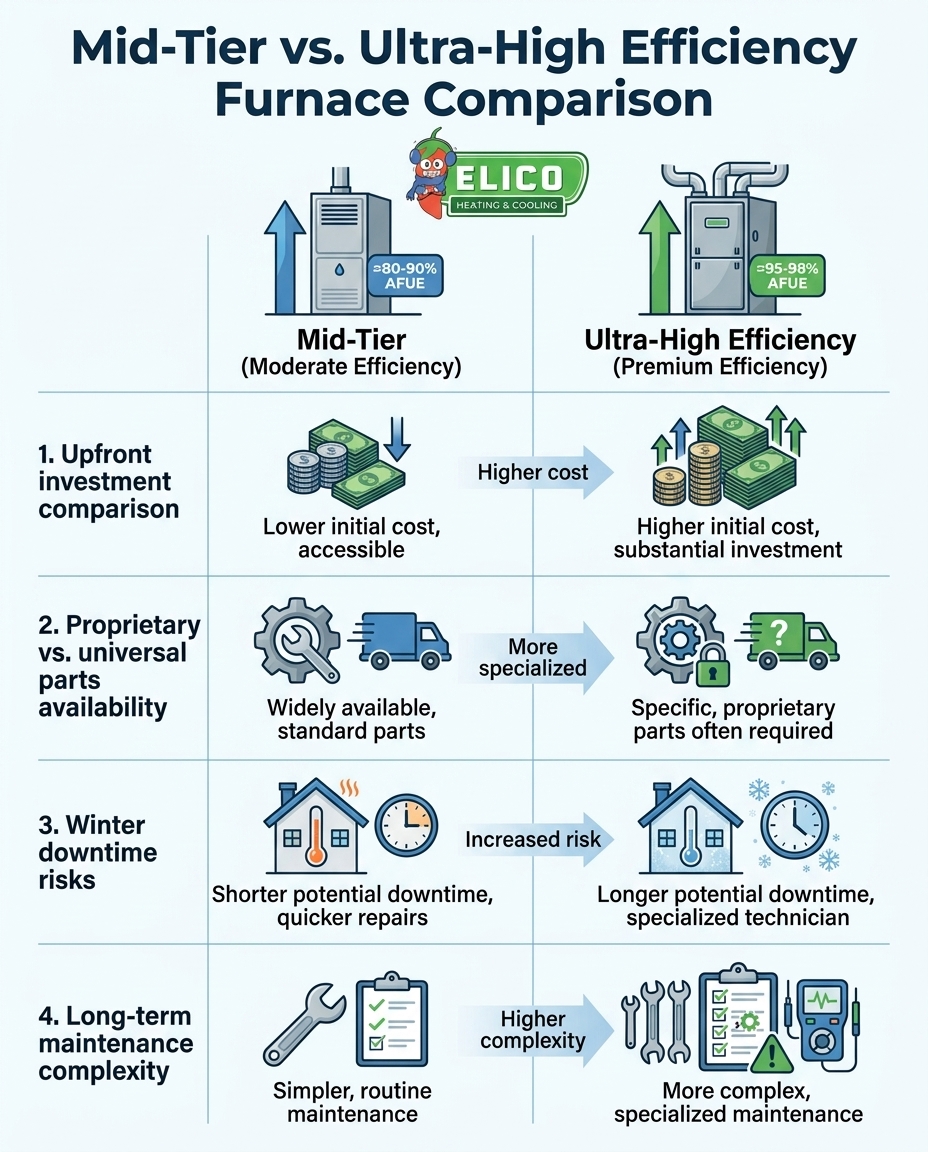
When you are looking at two vastly different proposals, placing the system types side-by-side helps clarify exactly what you are getting for your investment. Mid-tier systems, such as Ducane mid-tier furnaces, are built to serve as the benchmark for sensible, durable home heating. They provide excellent efficiency without the added vulnerability of overly complex internal electronics.
• Upfront Investment — Mid-Tier Systems (e.g., Ducane): Highly accessible, leaving room in the budget for quality installation and duct repairs. — Ultra-High Efficiency Systems: Requires a significant premium, extending the time it takes to see a return on investment.
• Parts Availability — Mid-Tier Systems (e.g., Ducane): Utilizes standard, universally available components that local supply houses keep in stock. — Ultra-High Efficiency Systems: Often relies on proprietary, manufacturer-specific parts that must be ordered directly.
• System Complexity — Mid-Tier Systems (e.g., Ducane): Straightforward, proven technology with fewer electronic sensors and communication boards. — Ultra-High Efficiency Systems: Highly complex, featuring secondary heat exchangers and modulating components.
• Long-Term Payback — Mid-Tier Systems (e.g., Ducane): Realistic payback period based on solid reliability and low ongoing maintenance costs. — Ultra-High Efficiency Systems: Extended payback period that can be easily wiped out by one major out-of-warranty repair.
The Reliability Factor
The most critical aspect of your heating system is whether it turns on when you need it. Ultra-high efficiency units rely on a network of delicate sensors to constantly monitor airflow, exhaust temperatures, and gas pressure. While this optimizes fuel usage, it also means that a slight variation—such as a partially dirty filter or a strong gust of wind against the exhaust pipe—can trigger a nuisance lockout, shutting the system down entirely. Mid-tier systems prioritize consistent operation over marginal energy extraction. They have fewer sensitive lockouts, meaning they keep running reliably through harsh conditions.
Maintenance and Repairability
Standard components are significantly easier and faster for technicians to service. When a mid-tier unit requires a new ignitor, flame sensor, or blower motor, the technician often has the replacement part sitting right on their truck. Conversely, ultra-high efficiency models often trap homeowners in a cycle of waiting on backordered, manufacturer-specific control boards. The complexity of these proprietary parts means that diagnosing and repairing them takes more time, which drives up your long-term maintenance costs.
Why Installation Quality Outweighs Brand Prestige
The HVAC industry has a poorly kept secret: the manufacturer's badge on the front of the cabinet matters far less than the skill of the technicians installing it. A flawless installation of a standard mid-tier unit will outperform a mediocre installation of the most expensive top-tier unit every single time. Your new equipment is not a plug-and-play appliance like a refrigerator; it is a complex mechanical system that must be custom-integrated into your home's unique ductwork and airflow dynamics.
Proper sizing, meticulous airflow calculations, and thorough ductwork sealing impact the lifespan of your equipment significantly more than the brand name. If a top-tier unit is installed on undersized ductwork, its expensive variable-speed blower will overwork itself, leading to premature failure and noisy operation. This is why lower quotes on quality mid-tier equipment often reflect honest, transparent pricing rather than cut corners, provided the installer is reputable and detail-oriented.
One local homeowner reached out during the winter needing a new system and seeking competitive pricing. They received a significantly lower quote than competitors for the exact same installation scope. The project was completed cleanly and professionally, proving that you do not have to overpay for prestige brands to get excellent results. If you are looking for furnace replacement in Valparaiso, focusing on the contractor's installation process will yield far better long-term comfort than focusing solely on the equipment brand.
The Winter Downtime Risk of Complex HVAC Systems
Energy savings look great on a spreadsheet, but they provide little comfort when your house is freezing. When extreme cold hits, immediate furnace reliability becomes a critical safety necessity, not just a matter of comfort. In the reality of harsh, freezing Valparaiso winters, a breakdown is an emergency that requires a swift resolution.
The proprietary parts problem: Ultra-high efficiency units often require highly specific, proprietary parts to function. If a specialized modulating gas valve or a unique communication board fails during a severe cold snap, local supply houses rarely have them in stock. This means the part must be shipped directly from the manufacturer, which can take days. Waiting three to four days for a circuit board while the temperature outside is in the single digits is a severe risk to your home's plumbing and your family's safety.
Readily available mid-tier parts ensure that emergency repairs can happen in hours, not days. Because systems like Ducane mid-tier furnaces use industry-standard components, a skilled technician can almost always source the necessary part locally and restore your heat on the same day. Understanding how easily your system can be fixed is just as important as knowing its efficiency rating. If you are currently dealing with erratic heating behavior, it is wise to learn the troubleshooting signs for your current furnace before a total breakdown occurs.
How to Compare Your Furnace Replacement Proposals Apples-to-Apples
Sorting through multiple quotes during the September pre-heating season requires a methodical approach. You cannot simply look at the final number at the bottom of the page; you have to evaluate the entire scope of work being offered. Here is a practical framework for reviewing your proposals.
1. Look past the top-line efficiency number: Evaluate the total scope of work included in the proposal. Does the quote include custom sheet metal transitions, new venting, duct sealing, or upgraded filtration? A thorough installation scope is far more valuable than a slightly higher AFUE rating.
2. Ask contractors directly about replacement parts: Do not hesitate to ask the estimator about the availability of replacement parts for the specific models they are quoting. If they admit that a proprietary board usually has to be ordered from out of state, factor that downtime risk into your decision.
3. Factor in generic energy rebates carefully: You may find that certain high-efficiency systems qualify for generic utility rebates or tax credits. While these can offset the initial investment, do not let them blind you to the long-term maintenance costs. Calculate whether the rebate actually covers the massive upfront premium.
4. Evaluate the transparency of the contractor: Are they aggressively pushing an upsell, or are they recommending what makes sense for your specific home? Honest, transparent pricing prioritizes your long-term return on investment (ROI) and reliability over selling the most expensive equipment on the market.
One homeowner experienced this firsthand during the spring when their heating system stopped working on a Thursday. They needed heat urgently by Saturday morning. The owner of the HVAC company came out personally on Saturday, evaluated the situation, and installed a better, more reliable system for significantly less than the other quotes the homeowner had received. This level of honesty and responsiveness is what you should look for in a contractor. If you are ready to move forward, exploring your HVAC financing options can help make the right choice fit comfortably into your budget.
Frequently Asked Questions About Furnace Quotes and Efficiency
Is a high efficiency furnace worth the extra cost?
The short answer is that it depends entirely on your local climate and how long you plan to stay in the home. While ultra-high efficiency models lower your monthly energy consumption, the massive upfront premium and increased repair costs often extend the payback period well beyond a decade. For many homeowners, a highly reliable mid-tier system offers a much better overall return on investment.
How do I compare furnace replacement quotes apples to apples?
You must look at the specific scope of work, not just the equipment model. Check if each quote includes the same level of detail regarding ductwork modifications, venting upgrades, and warranties. If one quote is significantly lower, ask the contractor to explain exactly what is included—often, a lower price on a mid-tier unit reflects honest pricing rather than missing components.
What are the common problems with high efficiency furnaces?
The most frequent issues stem from their complex internal electronics and sensitive safety sensors. These units are prone to nuisance lockouts caused by minor airflow restrictions or slight variations in gas pressure. Additionally, the secondary heat exchangers required to achieve these high ratings can become clogged or fail if the system is not meticulously maintained.
Are high efficiency furnaces less reliable than standard models?
They are not inherently defective, but they do have significantly more potential failure points. Because they rely on modulating valves and proprietary communication boards, there are simply more parts that can break down over time. Standard mid-tier models prioritize proven, straightforward mechanics, which typically results in fewer unexpected breakdowns.
How long is the typical payback period for an ultra-high efficiency furnace?
Depending on your current utility rates and usage, the payback period for the most expensive systems can range from 10 to 15 years. Unfortunately, this timeline can be completely reset if the unit requires a major, out-of-warranty repair involving proprietary electronic components. This is why many experts recommend focusing on durability and installation quality rather than chasing the highest possible efficiency rating.
Make the Smart Choice for Your Winter Comfort
Evaluating your options doesn't have to be an overwhelming process. The key takeaway is that a reliable mid-tier brand, like Ducane, is often the smartest, most durable choice for Valparaiso IN area homes. By focusing on proven technology and exceptional installation quality, you protect yourself from the severe winter downtime risks associated with overly complex equipment.
We encourage you to seek out transparent, ROI-focused consultations rather than falling for high-pressure sales pitches that push unnecessary upsells. When you are ready to make a confident decision about your home's comfort, reach out to schedule a professional evaluation for your furnace replacement. We are here to provide honest recommendations that keep your home warm and your budget intact.



HVAC Financing

Blogs

Upgrading Your Furnace and Water Heater Simultaneously: Cost Efficiencies and Equipment Synergy

Diagnosing Cold Spots in Your Schererville Home After Turning on the Furnace for the First Time